
Setting rent for the 2026-27 cycle in Los Angeles County requires knowing three things about your building: what jurisdiction it sits in, what year it was built, and where in the cycle you are. Get any one of those wrong and you can serve a notice that’s either legally invalid or leaves money on the table.
What follows is the full 2026-27 cycle picture: every jurisdiction with its own rent control ordinance, the allowable rent increase for each, the vintage exemption dates, and how the "stricter wins" rule sorts out the overlap between local rules and California’s state-default cap under AB 1482. If you want the visual reference we hand to clients, the guide is embedded and downloadable at the top of this article.
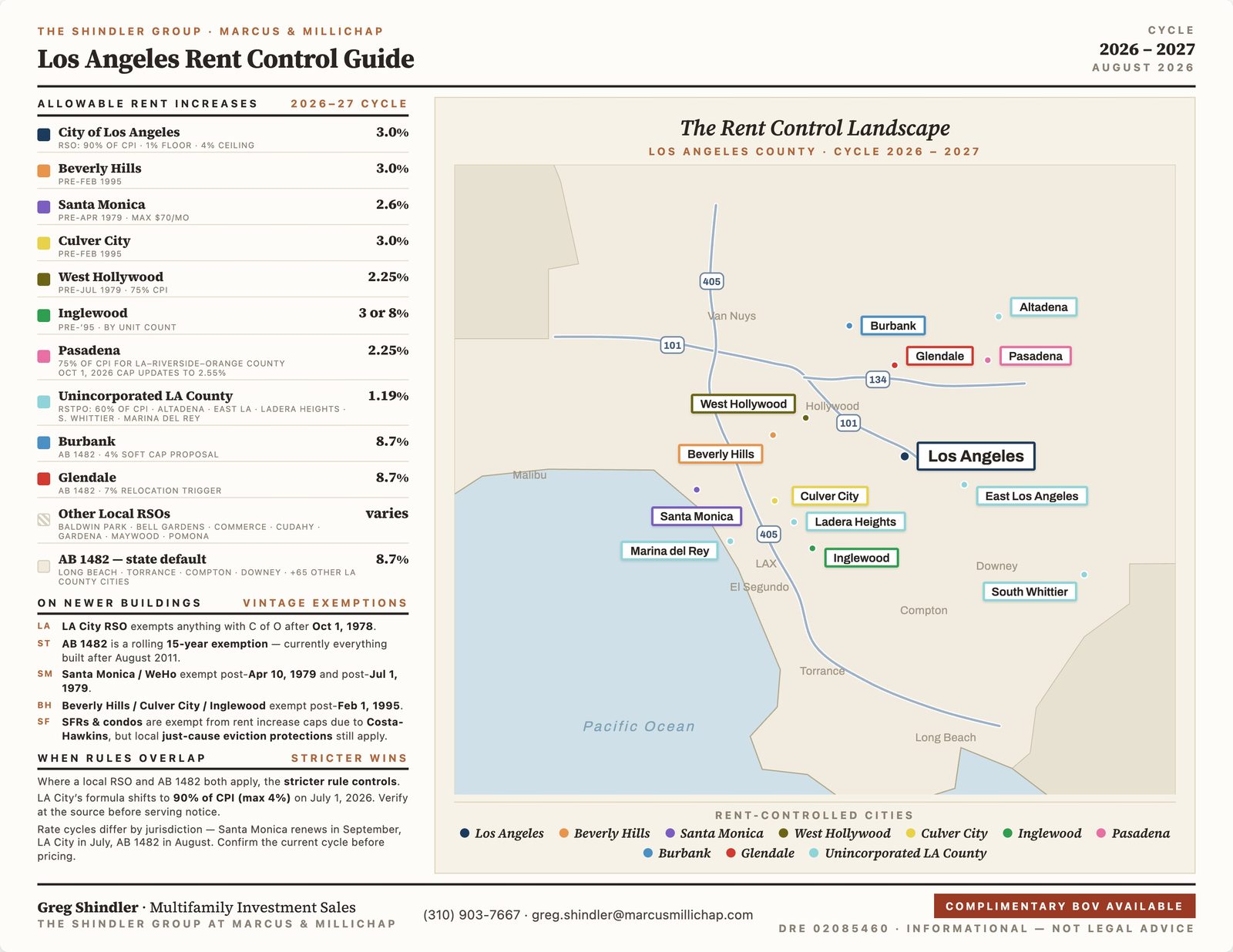
The 2026-27 Rate Table at a Glance
For LA County multifamily owners, the allowable rent increase for the 2026-27 cycle depends on which jurisdiction the building sits in and whether a local rent stabilization ordinance applies:
| Jurisdiction | 2026-27 Cap | Framework Notes |
|---|---|---|
| City of Los Angeles | 3.0% | RSO: 90% of CPI, 1% floor, 4% ceiling |
| Beverly Hills | 3.0% | Local RSO, pre-Feb 1995 vintage |
| Santa Monica | 2.6% | Local RSO, pre-Apr 1979 vintage, $70/mo max |
| Culver City | 3.0% | Local RSO, pre-Feb 1995 vintage |
| West Hollywood | 2.25% | Local RSO, 75% of CPI, pre-Jul 1979 vintage |
| Inglewood | 3% or 8% | Local RSO, pre-1995 vintage, rate depends on unit count |
| Pasadena | 2.25% | 75% of CPI for LA-Riverside-Orange County; cap updates to 2.55% on Oct 1, 2026 |
| Unincorporated LA County | 1.19% | RSTPO: 60% of CPI; covers Altadena, East LA, Ladera Heights, S. Whittier, Marina del Rey |
| Burbank | 8.7% | AB 1482 state default; 4% soft cap proposal under discussion |
| Glendale | 8.7% | AB 1482 state default; 7% relocation trigger |
| Other Local RSOs | varies | Baldwin Park, Bell Gardens, Commerce, Cudahy, Gardena, Maywood, Pomona |
| AB 1482 state default | 8.7% | Long Beach, Torrance, Compton, Downey, and 65+ other LA County cities without a local RSO |
The gap between the lowest cap (Unincorporated LA County at 1.19%) and the highest (AB 1482 default at 8.7%) is more than 7 percentage points. On a $50,000 annual rent roll, that is the difference between a $595 annual increase and a $4,350 annual increase. Knowing which framework applies to your building matters.
How LA County Rent Control Works
LA County’s rent control landscape is a two-layer system.
Layer one is state law. AB 1482, the California Tenant Protection Act of 2019, sets a statewide default cap of 5% plus regional CPI, absolute maximum 10%, on any covered rental unit. For the 2026-27 cycle in LA County, that default works out to 8.7%. AB 1482 also imposes just-cause eviction requirements and has a rolling 15-year vintage exemption, so newer construction rolls into coverage over time.
Layer two is local law. Individual cities and unincorporated LA County have their own rent stabilization ordinances (RSOs) that predate or add to AB 1482. Where a local RSO applies, its cap and its rules typically override AB 1482. Where no local RSO exists, AB 1482 is the fallback.
On top of both layers sits Costa-Hawkins, the state law that permanently exempts single-family homes and condos from rent increase caps regardless of local RSO. Local just-cause eviction rules still apply to those properties, but the annual rent cap does not.
The result: for any given LA County building, the actual allowable rent increase depends on where it sits, when it was built, and which of these three frameworks (local RSO, AB 1482, Costa-Hawkins) applies to it.
Local Rent Stabilization Ordinances
Every LA County jurisdiction with its own RSO has its own formula, its own vintage exemption, and its own cycle. Here is each one in turn.
City of Los Angeles (RSO)
2026-27 cap: 3.0%. The LA City Rent Stabilization Ordinance covers most multifamily buildings built with a Certificate of Occupancy on or before October 1, 1978. The current formula sets the annual cap at 90% of the regional CPI, with a 1% floor and a 4% ceiling. The 2026-27 cycle runs from July 1, 2026 through June 30, 2027, and the LA Housing Department publishes the new rate annually before it takes effect.
An important formula shift takes effect this cycle: LA City moved to a 90%-of-CPI formula with a 4% ceiling on July 1, 2026, replacing the older formula. For most owners that means the number to watch each summer is the LA Housing Department’s posted cap, not a fixed percentage.
Beyond the base cap, LA City RSO allows several pass-throughs on top of the annual increase: capital improvement cost recovery (CIP), utility surcharges for qualifying gas or water increases, and a Rental Increase Petition for justified operating cost increases. Rent freezes have also been imposed during emergencies, most recently the 2020-2024 COVID freeze.
Beverly Hills
2026-27 cap: 3.0%. Beverly Hills’ local ordinance covers buildings with a Certificate of Occupancy before February 1, 1995. Newer buildings fall to AB 1482 (or Costa-Hawkins exemption for SFRs and condos). The 3.0% cap for the 2026-27 cycle is well below the 8.7% AB 1482 default that would otherwise apply, which is the practical effect of "stricter wins" (see below).
Santa Monica
2026-27 cap: 2.6% (with a $70 per month absolute maximum). Santa Monica’s Rent Control Charter Amendment is one of the strictest in California. It covers buildings with a Certificate of Occupancy on or before April 10, 1979 and applies a dollar cap in addition to the percentage cap, so a unit currently renting at $3,500 could see at most $70/month regardless of what 2.6% would work out to. The Santa Monica cycle typically renews in September.
Culver City
2026-27 cap: 3.0%. Culver City’s RSO covers buildings with a Certificate of Occupancy before February 1, 1995, same vintage cutoff as Beverly Hills and Inglewood.
West Hollywood
2026-27 cap: 2.25%. West Hollywood’s RSO uses a 75% of CPI formula and covers buildings with a Certificate of Occupancy before July 1, 1979. The lower percentage of CPI produces one of the smaller allowable increases in the county.
Inglewood
2026-27 cap: 3% or 8% depending on unit count. Inglewood’s ordinance splits by building size, buildings with more units generally get the lower allowable increase. The vintage cutoff is pre-1995. Confirm current-year rates and the exact unit-count thresholds with the City of Inglewood before issuing a notice.
Pasadena
2026-27 cap: 2.25%, updating to 2.55% on October 1, 2026. Pasadena’s cap uses 75% of the CPI for the Los Angeles-Long Beach-Anaheim metropolitan area. The mid-cycle update on October 1, 2026 reflects the annual CPI reset built into the ordinance. If you are pricing a Pasadena increase for late 2026 or early 2027, use the post-October 1 rate.
Unincorporated LA County (RSTPO)
2026-27 cap: 1.19%. The LA County Rent Stabilization and Tenant Protection Ordinance (RSTPO) covers unincorporated areas, including Altadena, East Los Angeles, Ladera Heights, South Whittier, and Marina del Rey. The formula is 60% of CPI, producing one of the lowest caps in the county. RSTPO also carries the tighter tenant protections associated with LA County’s regulatory approach.
Other Local RSOs
Several smaller LA County cities have their own rent stabilization ordinances that produce jurisdiction-specific caps for the 2026-27 cycle: Baldwin Park, Bell Gardens, Commerce, Cudahy, Gardena, Maywood, and Pomona. Rates vary by ordinance. If you own in one of these cities, confirm the current cycle rate directly with the city’s rent stabilization office before serving a notice.
AB 1482 Default Jurisdictions
2026-27 cap: 8.7%. Where no local RSO applies, AB 1482 is the fallback framework and its 5% + CPI formula produces the 8.7% cap for the 2026-27 cycle in LA County. This is the largest legally allowable annual rent increase available anywhere in the county under a standard rent-controlled framework, and it applies to a substantial portion of LA County multifamily.
Burbank and Glendale both fall under AB 1482 for now. Burbank has a 4% soft cap proposal under discussion that could tighten things going forward, and Glendale carries a 7% relocation trigger under its local rules. Neither city currently has a full local RSO that overrides AB 1482, so the 8.7% state cap controls in the 2026-27 cycle.
Beyond Burbank and Glendale, AB 1482 is the operative cap for most other LA County cities without a local RSO, including Long Beach, Torrance, Compton, Downey, and 65+ other LA County cities.
Vintage Exemptions Explained
Every framework has a construction-date cutoff that decides whether it applies to your building. Get these dates wrong and you can end up capping rent on a building that doesn’t need to be capped, or worse, serving a notice that violates rules you didn’t realize applied. Here are the key vintage exemptions.
- LA City RSO: exempts anything with a Certificate of Occupancy after October 1, 1978.
- AB 1482: rolling 15-year exemption, so as of the 2026-27 cycle, buildings with a Certificate of Occupancy after August 2011 are exempt. This exemption rolls forward one month at a time as buildings age into coverage.
- Santa Monica / West Hollywood: exempt post-April 10, 1979 (Santa Monica) and post-July 1, 1979 (West Hollywood).
- Beverly Hills / Culver City / Inglewood: exempt post-February 1, 1995.
- Costa-Hawkins: single-family homes and condos are permanently exempt from rent increase caps, regardless of any other framework. Local just-cause eviction protections still apply.
For a newer LA multifamily building, the practical answer is often: no local RSO applies because the vintage cutoff is decades ago, and AB 1482 may or may not apply depending on whether construction crossed the rolling 15-year line. Verify at the source before pricing.
When Rules Overlap: Stricter Wins
Where a local RSO and AB 1482 both apply to the same building, the rule that produces the smaller allowable increase controls. In practical terms, that means for the 2026-27 cycle:
- An LA City building covered by RSO gets the 3.0% cap, not the 8.7% AB 1482 default.
- A Beverly Hills building covered by the local RSO gets 3.0%, not 8.7%.
- A Santa Monica building covered by the RSO gets 2.6% (or the $70/month cap, whichever binds), not 8.7%.
- An unincorporated LA County building covered by RSTPO gets 1.19%, not 8.7%.
Where "stricter wins" comes up as a live issue is often at the vintage line. If your building is right at the vintage cutoff for a local RSO, you need to confirm which framework actually applies before pricing an increase. Serving a notice under the AB 1482 cap for a building that’s actually covered by a local RSO is a compliance problem that can invalidate the notice and expose you to tenant claims.
Cycle Timing: When Rates Reset
Different jurisdictions reset their rates at different times of year, which matters if you’re pricing an increase near a cycle boundary:
- LA City RSO resets on July 1 each year.
- AB 1482 resets on August 1 each year (tied to the April CPI publication for LA-Long Beach-Anaheim).
- Santa Monica resets in September.
- Pasadena has a mid-cycle update on October 1, 2026 (2.25% to 2.55%).
- Other jurisdictions follow their own local schedules.
Because rates change on different dates, "the 2026-27 cycle" doesn’t start on the same day everywhere. A notice served in early July 2026 in LA City uses the new cycle’s rate; the same notice served in early July 2026 in an AB 1482 jurisdiction still uses the prior cycle’s rate until August 1. Confirm the current cycle before pricing.
What This Means for LA Multifamily Owners
For any building you own or are underwriting, the sequence is:
- Know your jurisdiction. Is the building inside a city with its own RSO, or in an unincorporated area, or in an AB 1482 default jurisdiction? A block one direction or the other can put you in a different regulatory framework entirely.
- Know your vintage. Certificate of Occupancy date determines which framework’s vintage exemption applies. For older buildings, this usually means the local RSO controls. For newer buildings, it may mean nothing controls (Costa-Hawkins), or that AB 1482 does.
- Know your cycle. Rates change on different dates in different jurisdictions. Serving a notice inside a cycle boundary using the wrong rate creates a compliance problem.
- Verify at the source. Before serving any rent increase notice, confirm the current published rate directly with the applicable rent stabilization office. This guide is informational, not a substitute for the official current-cycle rate.
For active portfolios spanning multiple LA County jurisdictions, this is a lot to track. A portfolio-wide rent review each summer, timed to the LA City July 1 reset, catches most of the operational questions in one pass.
Related in the legislative reference: AB 1482 for the state default cap deep-dive, SB 567 for the tighter owner move-in and substantial-remodel eviction rules that shape any value-add plan around rent-controlled buildings.